
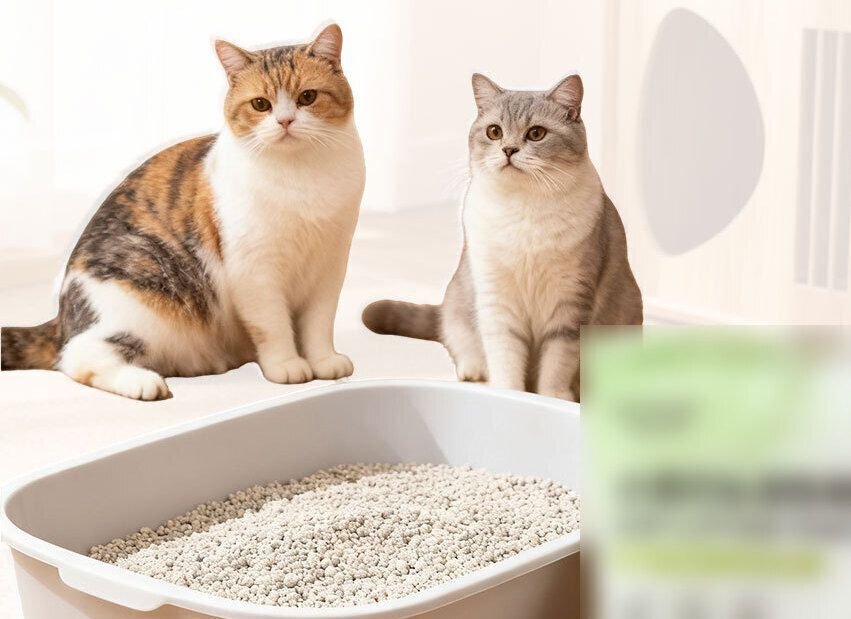
How to Choose a Good Cat Litter Deodorizer? A Wholesale Buyer’s Guide
Fragrance-Free Cat Litter Deodorizing Granules with Baking Soda, Activated Carbon and Activated Zeolite
Unpleasant litter box odors are one of the most common challenges for cat owners. Even with regular litter box cleaning, odors can develop from urine, organic waste and moisture, especially in multi-cat households.
For pet product distributors, importers and wholesalers, this creates an opportunity to offer more than just cat litter. Cat litter deodorizers are complementary consumable products that can help retailers expand their product range, increase basket value and encourage repeat purchases.
However, not all cat litter deodorizers are equally attractive to consumers.
Some products rely heavily on added fragrances to cover unpleasant smells, while others use functional ingredients to help manage odors. Particle size, dust control, ingredient quality and ease of use also influence the overall product experience.
So, what should professional buyers look for when sourcing a cat litter deodorizer?
In this guide, we explore the key purchasing factors and introduce a fragrance-free cat litter deodorizing granule formulation made with baking soda, activated carbon and activated zeolite.
1. Why Should Pet Retailers Add Cat Litter Deodorizers to Their Product Range?
Cat litter is a regular household purchase, but odor control remains an important concern for cat owners.
This makes litter deodorizing products a useful complementary category for pet retailers and distributors.
Complementary Product Sales
Cat litter deodorizers can be offered alongside bentonite litter, tofu litter, mixed litter and other cat litter products.
Retailers can recommend them as an additional litter box care product without requiring customers to change their existing litter brand.
Opportunities for Repeat Purchases
Deodorizing granules are consumable products. Once customers find a product that suits their household, they may purchase it regularly alongside their usual cat litter supplies.
For wholesalers, this creates an opportunity to develop a product category with ongoing replenishment potential.
Differentiation Through Fragrance-Free Formulations
Some consumers prefer litter box products without added fragrances, particularly those who dislike strong artificial scents.
Offering a fragrance-free deodorizer gives retailers another choice for customers who prefer odor management without adding a noticeable perfume smell.
Opportunities for Private Label Brands
Cat litter deodorizers can be developed with different ingredient proportions, particle specifications and packaging formats.
This provides flexibility for private label brands looking to create differentiated cat hygiene products.
2. What Should Buyers Look for When Choosing a Cat Litter Deodorizer?
For professional buyers, a good cat litter deodorizer should combine practical performance, consistent quality, consumer acceptance and competitive wholesale pricing.
Here are seven important factors to evaluate.
2.1 Effective Odor Control
Odor control is the primary reason consumers purchase these products.
Buyers should understand the ingredients and their respective functions rather than relying only on marketing claims.
A combination of different functional materials can provide multiple approaches to odor management.
However, actual performance depends on ingredient quality, formulation ratios, particle characteristics and usage conditions.
Ask suppliers for product samples and independent testing evidence wherever available.
2.2 Fragrance-Free Formulation
Fragrance-free cat litter deodorizers are an interesting option for consumers who prefer products without added perfume.
Unlike fragranced products that introduce another scent into the litter box environment, a fragrance-free formulation focuses on managing unwanted odors through its functional ingredients.
Potential retail advantages include:
- No added perfume fragrance.
- Suitable for fragrance-conscious consumers.
- An alternative to heavily scented litter accessories.
- Easier product positioning for retailers offering unscented pet care products.
Importers should distinguish between fragrance-free and hypoallergenic claims. A product without added fragrance should not automatically be described as hypoallergenic or completely non-irritating.
2.3 Fine and Consistent Particle Size
Particle size is an important consideration when selecting cat litter deodorizing granules.
Our product uses a 1–2 mm particle size specification.
This relatively fine granule format is designed for convenient distribution and mixing with cat litter.
Buyers should evaluate:
- Particle size consistency.
- Whether the granules are easy to pour.
- Whether they distribute evenly through the litter.
- Whether particles break during transportation.
- Dust generation during handling and use.
A consistent particle specification helps establish clearer product quality requirements between production batches.
2.4 Low Dust Performance
Dust is an important concern for cat owners.
Excessive dust can make a product unpleasant to pour and may affect the cleanliness of the litter area.
Professional buyers should request dust-control testing information and examine the actual test method and results.
A third-party test report provides additional evidence when comparing suppliers.
Our cat litter deodorizing granules have third-party testing documentation available. Relevant reports can be provided to buyers for review, subject to the report scope.
2.5 Suitable Compatibility with Different Cat Litters
Many households already have their preferred cat litter.
Some use bentonite litter, while others prefer tofu litter, mixed litter or silica gel litter.
A deodorizing additive that can work with different litter types may appeal to a wider customer base.
Before making compatibility claims, buyers should test the product with their intended litter types and check whether it affects:
- Litter clumping.
- Moisture absorption.
- Litter texture.
- Scooping convenience.
- Daily litter box maintenance.
Compatibility should be confirmed through practical testing rather than assumed from the ingredient list.
2.6 Consistent Ingredient Quality
For importers and wholesalers, consistent formulation is essential.
A sample may perform well, but customers expect the same experience with every replenishment order.
Important quality-control points include:
- Ingredient specifications.
- Formulation ratios.
- Particle size distribution.
- Moisture content.
- Dust levels.
- Color and appearance.
- Odor-control performance.
A supplier should be able to provide clear product specifications and explain how production consistency is maintained.
2.7 Convenient Retail Packaging
Packaging affects both retail presentation and product protection.
Our standard product packaging is 500g, a practical retail-oriented size for pet shops, online stores and other pet supply channels.
Buyers should also consider:
- Packaging material and moisture protection.
- Resealable packaging options.
- Clear ingredient information.
- Easy-to-understand usage instructions.
- Retail shelf presentation.
- Multipack and customized packaging possibilities.
For private label businesses, packaging design can also help create a distinctive product identity.
3. Understanding the Three Key Ingredients: Baking Soda + Activated Carbon + Activated Zeolite
One of the main features of our cat litter deodorizing granules is the combination of three functional ingredients.
Each ingredient has a different role in odor management.
Baking Soda – Helps Neutralize Certain Odor Compounds
Baking soda, also known as sodium bicarbonate, is widely used in household odor-control products.
It helps neutralize certain acidic odor compounds rather than simply covering unwanted smells with fragrance.
It is a familiar ingredient in many odor-management applications.
Activated Carbon – Porous Odor Adsorption
Activated carbon has a highly porous structure and a large internal surface area.
This allows it to adsorb various odor molecules.
It is commonly used in filtration and odor-control applications.
In cat litter deodorizing products, activated carbon provides an additional adsorption mechanism to support odor management.
Activated Zeolite – A Porous Mineral Material
Zeolite is a porous aluminosilicate mineral used in various adsorption and filtration applications.
Depending on its type and characteristics, activated zeolite can contribute to moisture adsorption and the management of certain odor-related compounds.
Its performance depends on the mineral structure, activation process and formulation.
Why Combine These Three Ingredients?
Rather than relying on a single ingredient, combining baking soda, activated carbon and activated zeolite provides different functional mechanisms.
| Ingredient | Main Function |
|---|---|
| Baking Soda | Helps neutralize certain acidic odor compounds |
| Activated Carbon | Adsorbs various odor molecules |
| Activated Zeolite | Supports moisture adsorption and odor management |
The combination offers a practical formulation approach for developing fragrance-free cat litter deodorizing products.
4. Our Fragrance-Free Cat Litter Deodorizing Granules
At Meadow Streams, we supply cat litter deodorizing granules formulated with:
Baking Soda + Activated Carbon + Activated Zeolite
The product is designed for businesses looking to offer a fragrance-free cat litter odor-control accessory.
Key Product Specifications
| Specification | Details |
|---|---|
| Product | Cat Litter Deodorizing Granules |
| Main ingredients | Baking Soda + Activated Carbon + Activated Zeolite |
| Fragrance | Fragrance-free |
| Particle size | 1–2 mm |
| Standard packaging | 500g |
| Formulation | Adjustable ingredient ratios |
| Testing documentation | Third-party test reports available |
| Target customers | Importers, distributors, wholesalers and private label brands |
Six Reasons to Consider Our Product
- Fragrance-Free Formulation: No added fragrance. An alternative for consumers who prefer litter box products without noticeable perfume scents.
- Three Functional Ingredients: Combines baking soda, activated carbon and activated zeolite to support different odor-management mechanisms.
- Fine 1–2 mm Granules: A defined particle size specification designed for convenient pouring and mixing with cat litter.
- Third-Party Testing Documentation: Independent testing reports are available to support buyer evaluation of relevant product performance, including the applicable dust-control or deodorizing test results.
- Adjustable Formulation Ratios: The proportions of baking soda, activated carbon and activated zeolite can be adjusted according to product development requirements and target market positioning.
- Convenient 500g Retail Pack: A practical standard pack size for pet shops, online retailers, distributors and private label product ranges.
5. How Should Buyers Evaluate a Cat Litter Deodorizer Before Ordering?
Before placing a wholesale order, professional buyers should follow a structured sample-testing process.
Step 1: Review the Ingredients
Request the ingredient specification and understand the role of each component.
Check the quality and specifications of baking soda, activated carbon and activated zeolite.
Step 2: Check Third-Party Test Reports
Ask for available testing documents.
Pay attention to the testing organization, test method, sample identification, test date and actual results.
Make sure the report relates to the product being supplied.
Step 3: Test Odor-Control Performance
Compare different formulations using the same type and quantity of cat litter.
Where possible, request standardized testing results or independent laboratory evidence.
Step 4: Evaluate Dust and Particle Quality
Check the 1–2 mm granules during pouring and mixing.
Observe dust generation, particle consistency and whether the granules break easily.
Step 5: Test Different Cat Litter Types
Evaluate compatibility with bentonite litter, tofu litter and other intended applications.
Check whether the deodorizer affects clumping, scooping or daily litter box maintenance.
Step 6: Review Packaging and Storage
Check the 500g packaging, moisture protection, sealing quality and shelf-life information.
Step 7: Compare Wholesale Costs
Consider the complete offer, including formulation, packaging, MOQ, transportation and production lead time.
The best supplier is not necessarily the one offering the lowest price, but the one delivering consistent quality and a commercially viable product.
6. Who Should Consider Stocking Fragrance-Free Cat Litter Deodorizers?
This product category is particularly relevant to businesses already selling cat litter and other pet consumables.
Cat Litter Importers and Distributors
Importers can add deodorizing granules to an existing cat litter portfolio and offer retailers an additional complementary product.
Pet Product Wholesalers
Wholesalers can expand their cat hygiene range with another consumable product that customers may purchase alongside cat litter.
Pet Shops and Retail Chains
Retailers can offer a fragrance-free alternative to customers who prefer not to use heavily scented litter accessories.
Private Label Pet Brands
Brands can explore customized ingredient proportions, packaging and product specifications to develop their own cat litter care products.
E-commerce Pet Supply Sellers
Online retailers can create product bundles combining cat litter, litter box accessories and deodorizing granules.
7. Frequently Asked Questions
Q1: Does this cat litter deodorizer contain fragrance?
No. Our standard formulation is completely fragrance-free, with no added perfume fragrance.
Q2: What is the particle size?
The standard particle size is approximately 1–2 mm.
Q3: What are the main ingredients?
The product combines baking soda, activated carbon and activated zeolite. The ingredient proportions can be adjusted according to product development requirements.
Q4: Is there a third-party test report?
Yes. Third-party testing documentation is available. Buyers can request the relevant reports to review the applicable test methods and results.
Q5: Can it be used with different types of cat litter?
Compatibility should be confirmed through practical testing. Buyers can evaluate the product with bentonite, tofu and other intended litter types before launching it.
Q6: What is the standard package size?
Our standard retail-oriented packaging is 500g. Other packaging requirements can be discussed according to order quantity and production capabilities.
Q7: Can distributors develop their own formulations?
Yes. The proportions of baking soda, activated carbon and activated zeolite can be adjusted according to agreed product specifications and development requirements.
Q8: Does this product replace regular litter box cleaning?
No. Deodorizing granules are supplementary litter care products. Regular removal of waste, litter replacement and proper ventilation remain essential.
8. Develop Your Cat Litter Care Product Range with Meadow Streams
A good cat litter deodorizer should offer more than an attractive package or a strong fragrance.
It should combine practical odor management, consistent ingredient quality, suitable particle size, convenient packaging and reliable supply.
Our fragrance-free cat litter deodorizing granules combine baking soda, activated carbon and activated zeolite in a 1–2 mm particle format, with a convenient 500g standard pack and third-party testing documentation available.
For importers, distributors and wholesalers, this is an opportunity to add a complementary cat hygiene product to an existing pet supplies portfolio.
At Meadow Streams, we focus on garden and pet care supplies for international wholesale markets.
We welcome inquiries from:
- Cat litter importers and distributors.
- Pet product wholesalers.
- Pet shops and retail chains.
- Private label pet brands.
- E-commerce pet supply businesses.
Looking for a fragrance-free cat litter deodorizer supplier?
Contact Meadow Streams to request product specifications, third-party testing documents, samples and wholesale quotations.
Website: https://meadowstreams.com
Meadow Streams – Practical Garden & Pet Supplies for Wholesale Partners.